The Move Only You Can Make
A Field Guide for founders navigating a move other people can't yet understand
Every threshold comes with an obvious next move. And often, the threshold is yours before it's your business's: you've changed, what you want from your work has changed. You want to reach for something more or different, but the way things run now won't get you there.
The obvious move rarely takes any of that into account. When things are working but each year of growth takes more effort than the last, it usually means more: another senior hire, a new product line, a new market, a funding round, the tools everyone else seems to be buying. It's the move that makes sense the moment you say it out loud, the one your board, your peers and your LinkedIn feed would all nod at.
Sometimes the obvious move is right. But if your next move is easy to explain, it's worth being a little suspicious of it. The moves that matter most are often the ones that don't fit a template yet: the business model nobody in your industry has tried, the offering you can't quite name but know would be a breakthrough, the direction that seems like a complete pivot, the smaller, sharper company hiding inside the one you've built. They're hard to explain because they're new, and that makes them hard to trust, including for you.
This Field Guide is for that moment. It walks you through how to tell the move that's easy to explain apart from the move only you can make, and how to act on the second without waiting for the world to approve it first.
You'll need about an hour, a notebook, and one real decision you're facing. It works best on your own first, then with one or two people you trust.
How it works:
- Name the obvious move
- Separate the voices that are pushing you towards it
- Draft a working Flourishing Thesis
- Test both moves against it
- Make it legible enough, to the right people
- Build a bridge: one small, reversible experiment
Why the obvious move is so tempting
The obvious move has three things going for it, and none of them is that it's right for you.
- It's legible. People understand it immediately. You don't have to defend it at dinner.
- It comes with approval built in. Someone has already decided it's a good move: a growth plan, an industry norm, an investor's playbook.
- It comes with a template. There's a path to follow, people who've done it, and a story about how it ends.
The move only you can make has none of these. It's often illegible, even to you. There's no template, because nobody has quite been where you are, with your combination of experience, business, values and timing.
In an earlier Field Note, I wrote about what happens when we wait for legitimacy to arrive before we act: legitimacy is usually defined by existing norms, so anything genuinely new looks illegitimate at first (There is a cost to waiting for legitimacy to arrive). The absence of a template isn't proof that a move is wrong. Sometimes it means you need a different lens to see it.
This guide gives you that lens, and some practical ways to use it.
Step 1: Name the obvious move
Start by writing down the move you'd make if your only goal were for it to make sense to everyone else. Be specific and honest. Then answer four questions about it:
- Who would approve of this move? Name them: your board, your team, your peers, your family, your industry.
- What does it protect? Revenue, status, an identity, a relationship, a plan you've already announced to your team.
- What story would you tell about it? Write the one-sentence version you'd give at a dinner party.
- What does it cost that won't show up in the numbers? What would you have to keep doing, or stop doing, to make it work?
Then write down the other move: the one you keep circling back to, even if it's half-formed. Don't defend it yet. Just describe it in a few lines.
Step 2: Separate the voices
When a decision feels stuck, it's usually because several parts of you are speaking at once. Fear. Ambition. Responsibility. Loyalty. Curiosity. Each one carries real information, and none of them should be making the decision alone.
I find it helpful to distinguish between two kinds of will:
- Reactive will sounds like "I should", "I have to", "I can't afford not to". It's driven by pressure: other people's expectations, fear of falling behind, the need to look like you're on track.
- Creative will sounds like "I choose", "this matters to me because…", "I'm willing to". It comes from a grounded sense of what you value and what you're building.
Try this. Draw two columns. For each move, write down every reason you have for it, then label each reason: R for reactive or C for creative. Then ask, for the obvious move and the other one: who is doing the choosing here?
The point isn't to silence the reactive voices. Security matters. Reputation matters. The point is to hear them as information, so they stop making the decision for you.
Step 3: Draft a working Flourishing Thesis
To judge a move that has no template, you need a standard of your own. That's what a Flourishing Thesis gives you.
Your Flourishing Thesis is your working theory of the highest good: what your life and work are ultimately for, and what it takes to get there. It names what can and cannot be sacrificed along the way, what the journey demands of you, and who you might become if you stay true to it. Everyone holds one. Few of us have examined ours. We absorb it from family, schooling, industries and institutions, each with its own picture of success built in. It's a thesis because it's a working theory: firm enough to hold you to account, open enough to be tested and revised as you learn.
It isn't a values list. Values describe the traveller. A Flourishing Thesis describes the journey: what it's reaching for, what it's worth, and what it must not cost.
You don't need a finished thesis for this guide. A first draft is enough. Answer the four questions at its heart in a sentence or two each:
- What are you actually in pursuit of? Not a mission statement: the good you're after in your own life. Pick one thing you're working towards and ask "and what would that give me?" three times. I am in pursuit of … because I believe it will …
- What journey do you believe you're on to get there? What it will take, who's on it with you, and what it must not cost: your health, your family, your belonging, your integrity. The journey I believe I'm on asks me to … It is worth it because … and it must not cost …
- What does flourishing within it look like? Picture a good, ordinary week inside this journey, and the signals that tell you you're drifting. Flourishing looks like … I'll know I'm off course when …
- How will you relate to the pressures shaping your decisions? Whose approval you're anticipating, which pressures are worth carrying, and which you'll step back from. The pressures worth enduring are … The ones I will step back from are …
Before you keep it, check two things: does it rule something out, and would someone who knows you well recognise you in it?
If you want to go deeper, the free Flourishing Thesis workbook takes you through it in full.
Step 4: Test both moves against your thesis
Now put the two moves side by side, and judge them by your standard instead of the world's. Answer each question for both:
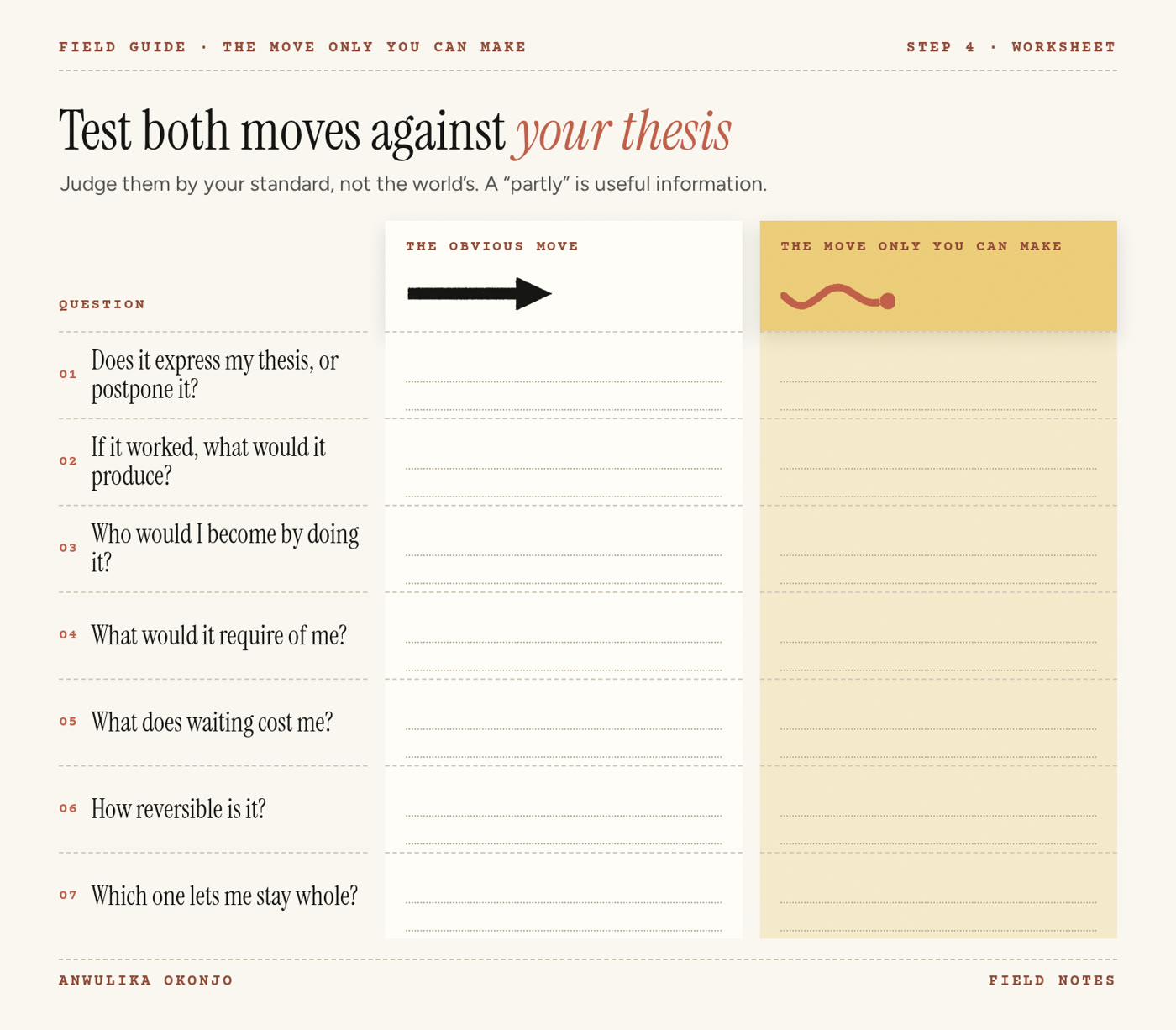
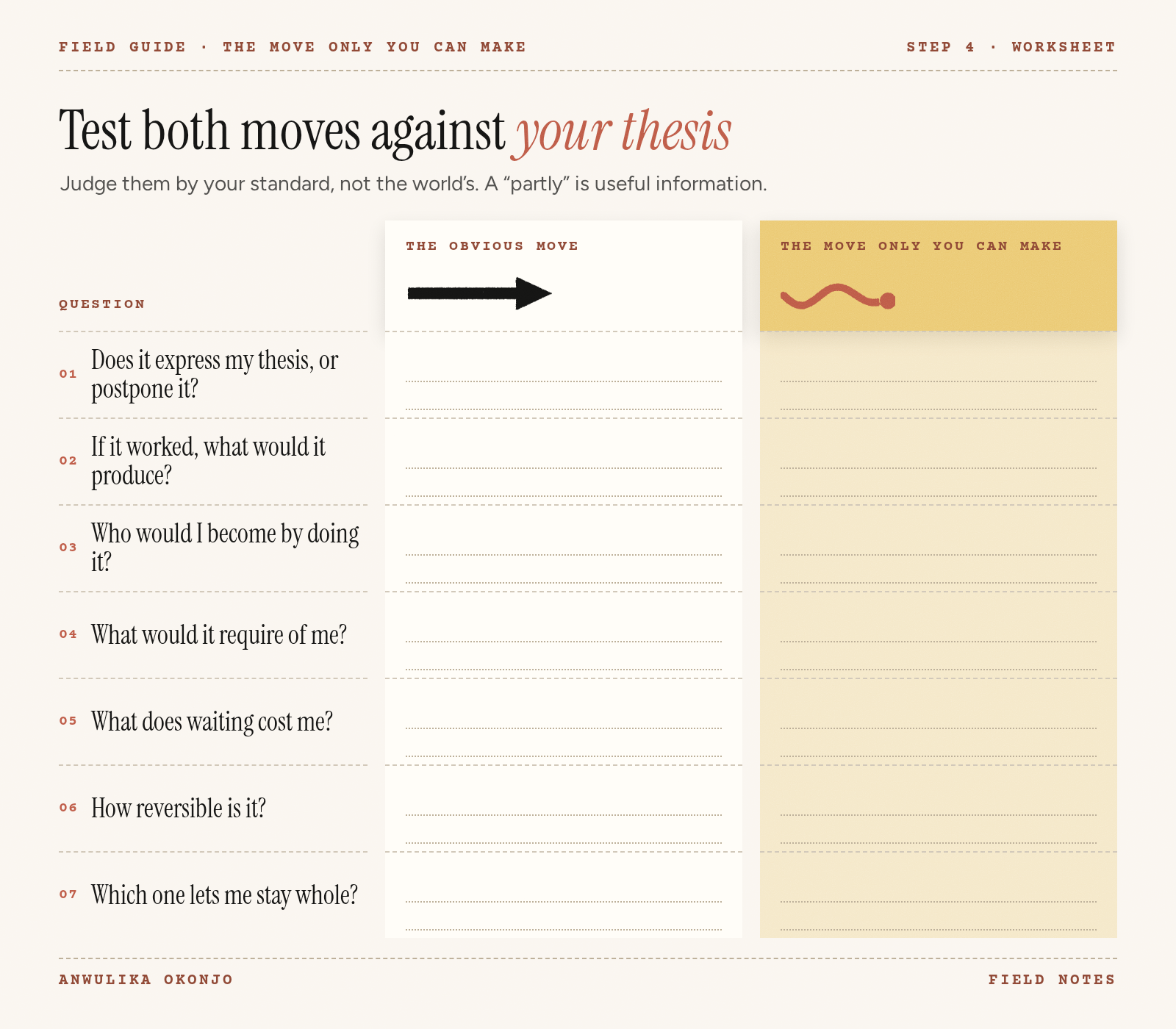
Two things usually happen at this point. The obvious move looks less inevitable. And a third option starts to appear: a version of the move only you can make that's smaller, safer and easier to start. That's what the next two steps are for.
Step 5: Make it legible enough, to the right people
The move only you can make doesn't need to be legible to everyone. It needs to be legible enough to the few people whose input will actually help you, and to yourself.
Write one paragraph. Describe the move as if to a thoughtful friend: what it is, why it matters to you, and what you'd need to learn to know whether it's working. Leave out the defence. This is a first draft of a new story, and it's allowed to be unfinished.
Choose three people. Pick:
- someone who has done something similar, even in a different field;
- someone who knows you well and wants you to flourish;
- someone who will challenge you honestly.
Ask sharper questions. "What do you think?" invites people to judge your move by their own template. Try these instead:
- "What would you need to see to believe this could work?"
- "What am I not seeing?"
- "What lens are you using when you think about this?"
That last question matters. Every adviser has their own thesis about what a good move looks like. Their input is information about the move, and also about their lens. Notice whose standards you're applying when you weigh what they say.
Look for examples, not templates. Find two or three people who made a move with a similar shape. You're not looking for a path to copy, just evidence that the shape is possible.
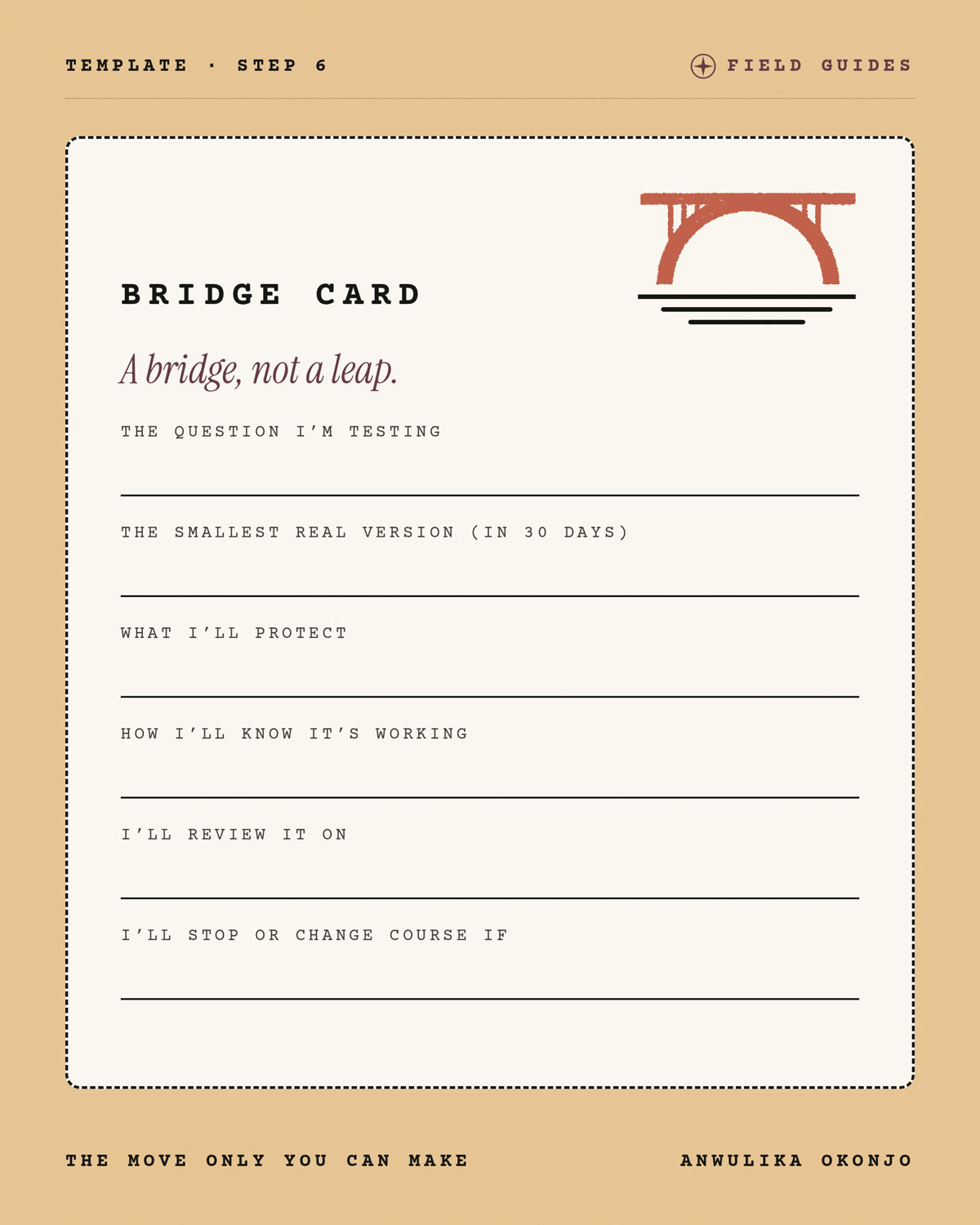
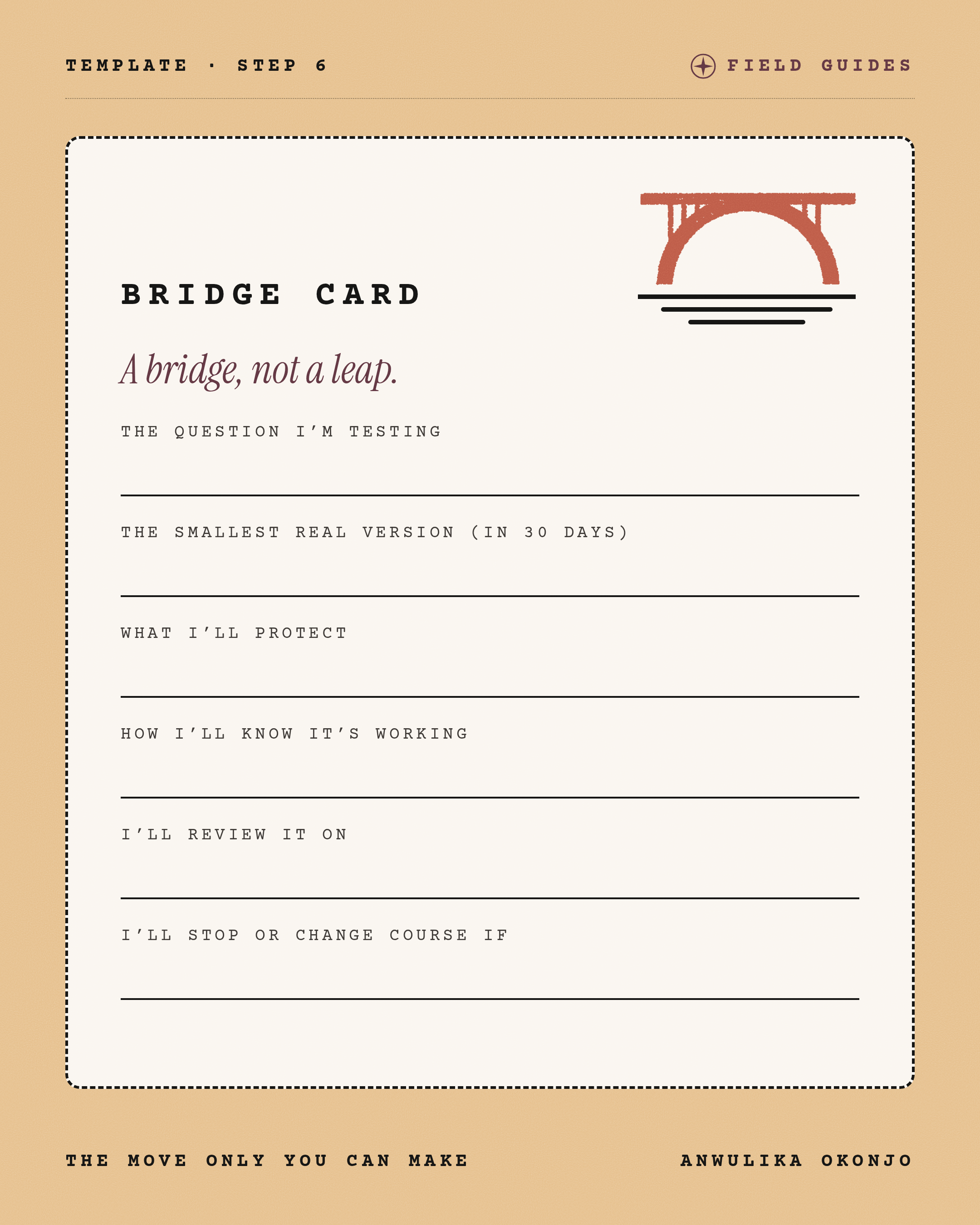
Step 6: Build a bridge
The move only you can make rarely needs a leap. It needs a bridge: a small, reversible experiment that lets you learn whether the move is real before you bet everything on it. Waiting for certainty is just another way of waiting for legitimacy. An experiment lets you create your own evidence.
Design yours with these six lines:
- The question I'm testing: what do I most need to learn?
- The smallest real version: what can I start within 30 days?
- What I'll protect: runway, relationships, health, reputation
- How I'll know: the signals that would tell me it's working
- Review date: when I'll stop and look honestly
- Stop condition: what would make me end or change course
Get the next field note in your inbox
Let’s turn the lens on you
You don't need the whole path to be visible. You need a standard of your own, a few people who can see what you're building, and one honest experiment.
Get the workbook. The Flourishing Thesis workbook takes Step 3 further, so you can build a standard of your own that holds when the template runs out.
Keep building it, with support. If you'd like company in this work, join me in the Reinvention Lab. It's a membership for founders and independent builders working out what their business should become now and designing that future deliberately. Each month, we meet live to do this kind of thinking together. Our first call is on Thursday 12 November.
Which question stayed with you?
No account needed. Your email is optional and never shown; add it if you’d like replies. Responses appear once I’ve read them.